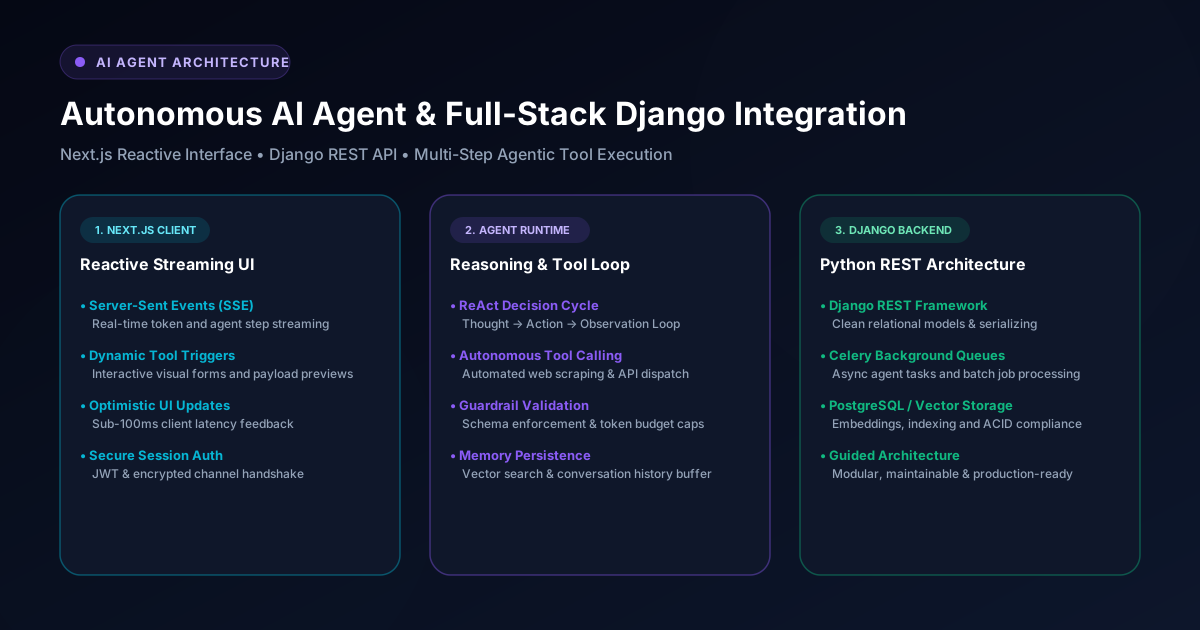
Home/Projects/Autonomous AI Agent & Full-Stack Django Integration AI Engineering & Full-Stack SystemsModern applications are shifting from static interfaces to autonomous, agentic systems. In this project showcase, we highlight the engineering of an AI Agent pipeline that couples a reactive Next.js UI with a robust Python/Django backend. The system executes multi-step reasoning, dynamic tool invocation, web scraping, and database persistence, while serving as a foundational blueprint for guiding developers and students building complex full-stack web architectures.
GalleryProject Screenshots
A visual walkthrough of the website showcasing layouts, user experience, responsive design and overall interface.
Project Overview
Businesses and academic teams increasingly require practical AI capabilities that go beyond simple chat prompts. This project demonstrates how to structure a production-grade full-stack system where an AI agent can inspect data, make decisions, invoke backend tools, and return structured results into a Next.js interface.
Project Information
Category
AI Engineering & Full-Stack Systems
Technologies
AI AgentsPythonDjango REST FrameworkNext.js (App Router)React.jsPostgreSQLGemini / OpenAI APITailwind CSS
Challenge
Orchestrating agentic workflows involves tackling unreliability: uncontrolled token spend, hallucinations during multi-step reasoning, managing long-running tasks asynchronously without freezing UI responsiveness, and architecting a clean Django backend that separates relational data from agent state.
Solution
Constructed a modular 3-tier architecture: 1) Next.js App Router frontend delivering real-time streaming updates via Server-Sent Events; 2) Python-driven AI Agent orchestrator utilizing structured JSON schemas for deterministic tool execution; and 3) Robust Django REST framework backend managing authentication, database persistence, celery task queuing, and relational business logic.
FeaturesKey Features
The project was developed with a strong focus on usability, performance, scalability and business goals while delivering a seamless user experience.
Autonomous Decision Loop
ReAct-style reasoning cycle allowing the agent to formulate hypotheses, select appropriate tools, inspect results, and iterate autonomously.
Django REST Architecture
Clean MVC/MVT structure in Django with secure JWT authentication, relational PostgreSQL schemas, and modular API endpoints.
Real-Time Streaming UI
Next.js frontend using Server-Sent Events (SSE) to render agent thinking steps, intermediate tool outputs, and final responses smoothly.
Tool Calling & Data Automation
Equipped with custom Python tools for web data extraction, document parsing, and database queries guarded by strict parameter validation.
Guidance & Mentorship Framework
Structured codebase designed to guide college students and junior developers in mastering modern Python, Django, and AI system design.
Technology StackTechnologies Used
The project was developed using modern technologies, frameworks and tools to ensure scalability, maintainability and high performance.
AI Agents
Artificial Intelligence & Agents
Python
Backend & AI Language
Django REST Framework
Python Web Framework
Next.js (App Router)
React Framework
PostgreSQL
Technology Used
Gemini / OpenAI API
Artificial Intelligence & Agents
Tailwind CSS
Utility-first CSS
Project Highlights
Autonomous Multi-Step Reasoning Loop
Django REST API & Model Serializers
Next.js Real-time Token Streaming (SSE)
Dynamic Tool Calling & Web Scraping
Vector Memory & Query Orchestration
Academic & Developer Project Mentorship
Results
Seamless integration between modern Next.js frontends and Python/Django backends
Deterministic, schema-validated tool calling with zero hallucinated API parameters
Proven framework utilized for guiding student capstones and commercial automation
Async execution preventing server timeouts during complex multi-step reasoning
Clean, modular codebase readily adaptable for custom enterprise agent workflows
Key Outcomes
Autonomous Multi-Step Tool Execution
Sub-100ms Streaming UI Feedback
Production-Ready Django Architecture
Forensic Analysis & Code Walkthrough
Detailed inspection of the engineering challenges, event lifecycles, and code implementations designed to resolve critical production issues.
3-Tier System DesignArchitecture: Reactive Frontend Meets Python Intelligence
The system marries the visual velocity of Next.js with the algorithmic power of Python and Django. Users submit goals through an interactive dashboard; the request triggers an asynchronous agent worker in Django, which plans actions, executes tools, and streams tokens back to the browser.
Django REST Framework Agent Tool Endpoint
python# Django REST View for Autonomous Agent Dispatch
from rest_framework.views import APIView
from rest_framework.response import Response
from rest_framework.permissions import IsAuthenticated
class AgentExecutionView(APIView):
permission_classes = [IsAuthenticated]
def post(self, request):
task_prompt = request.data.get('prompt')
agent_session = AgentOrchestrator(user=request.user)
execution_id = agent_session.dispatch_async(task_prompt)
return Response({'status': 'queued', 'execution_id': execution_id})
Tool Execution & Deterministic Validation
Rather than trusting raw text output, all tool calls are parsed against strict parameter contracts before execution. If the agent generates an invalid argument, an immediate feedback reflection loop prompts the model to correct itself before touching production APIs or databases.
Agent Tool Invocation & Schema Guardrail
pythondef execute_agent_tool(tool_name: str, arguments: dict):
tool = TOOL_REGISTRY.get(tool_name)
if not tool:
raise ValueError(f'Unknown tool: {tool_name}')
validated_args = tool.schema.validate(arguments)
result = tool.run(**validated_args)
return {'tool': tool_name, 'result': result}
Academic & Developer Guidance Blueprint
Beyond commercial automation, this architecture builds directly upon foundational academic engineering — including the Multi-Modal Medical Imaging Integration Web Application (Django + TensorFlow + U-Net Segmentation) developed at Madras Institute of Technology (Anna University). This project serves as an active blueprint for mentoring engineering students and developers in mastering Django ORM, REST API design, deep learning model deployment, and asynchronous system architecture. Explore the open-source repository at https://github.com/aravindhakumar-dev/medicalimaging.
Multi-Modal Medical Image Fusion & Inference (Django + TensorFlow)
python# Multi-Modal Image Fusion Pipeline (Django + TensorFlow)
import tensorflow as tf
def fuse_modalities(features_list):
"""
Concatenates feature maps from MRI, CT, PET & Ultrasound scans
and passes through dense representation for clinical diagnosis.
"""
fused_features = tf.concat(features_list, axis=-1)
fusion_output = tf.keras.layers.Dense(128, activation='relu')(fused_features)
return fusion_output
Key Engineering LessonsArchitectural Takeaways & Best Practices
1Separate Agent Reasoning from State: Keep the LLM orchestration layer decoupled from your relational database models for maximum testability and speed.
2Enforce Strict Schema Contracts: Use Pydantic or Django serializers to validate tool inputs before execution to eliminate runtime errors.
3Stream Feedback Early: In agentic systems where multi-step tasks take several seconds, streaming intermediate status keeps users informed and engaged.
Let's Build TogetherInterested in building a similar solution?
Looking for a high-performance, SEO-friendly website or web application tailored to your business? Let's discuss your project.
Additional ExperienceMore client and agency development experience
Beyond the showcased projects, I have contributed to numerous WordPress themes, custom plugins, WooCommerce, booking systems, Next.js and React web application projects involving technical SEO, website optimization, performance engineering, hosting migration, maintenance, landing pages and enterprise business websites.
Certain projects cannot be publicly displayed because of company policies and client confidentiality agreements.